
Bocce Ball Rules
USBF and Special Olympics play, from the opening pallino through scoring and foul remedies.
- Court
- 86.92 × 13.12 ft(26.5 × 4 m)
- Players
- 2 to 8 players; each throws 2 or 4 balls
- Scoring
- Count each closer ball for the scoring side
- Winning
- Usually reach 12 after a complete frame
Court and dimensions
USBF Open Rules court


All measurements and other layouts
| Dimension | Imperial | Metric |
|---|---|---|
| Length | 86.92 ft | 26.5 m |
| Width | 13.12 ft | 4 m |
| Foul line from end | 13 ft | 3.96 m |
| Centre line from end | 43.46 ft | 13.25 m |
| Pallino area starts | 43.46 ft | 13.25 m |
| Pallino area ends | 73.92 ft | 22.54 m |
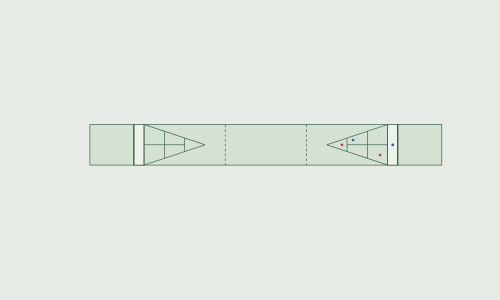
The USBF prints an 86.92 × 13.12 ft court and recommends one pointing and shooting line 13 ft from each back wall. A valid opening pallino stops between the centre line and the far foul line, touching neither.
| Dimension | Imperial | Metric |
|---|---|---|
| Length | 60 ft | 18.29 m |
| Width | 12 ft | 3.66 m |
| Foul line from end | 10 ft | 3.05 m |
| Centre line from end | 30 ft | 9.14 m |
| Pallino area starts | 30 ft | 9.14 m |
| Pallino area ends | 50 ft | 15.24 m |
The 60 × 12 ft court has a foul line 10 ft from each backboard and a 30 ft half-court marker. The opening pallina must stop beyond that marker and before the opposite foul line.
How to play
Equipment
Bocce ball
8 ×Size and equipment notes
Key size 106–110 mm
USBF singles and doubles play four balls per side; triples use twelve balls, three players throwing two each; foursomes station two players at each end, each throwing two balls.
USBF's tournament standard is 106–107 mm and 900–920 g; Special Olympics permits 107–110 mm.
Pallino (jack)
1 ×Size and equipment notes
Key size 48–63 mm
Its colour must differ from both teams under Special Olympics rules.
Special Olympics permits a 48–63 mm pallina.
Measuring device
1 ×Size and equipment notes
USBF lists tape measures, antennae, expanding pens, string devices and laser tools; Special Olympics accepts any accurate device its officials approve.
Setup
The pallino is the small target ball. In each frame both sides roll their larger balls toward it, and the side whose balls finish closest scores. A frame ends when every ball has been rolled; a game is a run of frames to the target score.
The USBF court measures 86.92 ft (26.5 m) by 13.12 ft (4 m). Mark the shared pointing and shooting line 13 ft (3.96 m) from each back wall, then mark the centre line. The court dimensions page covers both layouts.
Set out 8 balls for ordinary play and 1 pallino. Keep a measuring device nearby.
For USBF play, the coin-toss winner chooses the starting end and controls the pallino; the opponent chooses ball colour.
A valid USBF opening pallino stops between the centre line and the far foul line, touching neither.
USBF names two shooting styles from one foul line: raffa is forceful and near ground level, and volo lofts the ball at the target; pointing is the gentler roll toward the pallino. (USBF court rules, p. 4; SO 2024 rulebook, §7) A first game needs only the roll toward the pallino.
An opening pallino that stops short, long or on a line is invalid; see Common disputes for what each code does next.
Roll until your side is closest
The side that placed the pallino rolls the first ball. From then on, the side whose nearest ball is farther from the pallino, the out side, keeps rolling until it gets closer or runs out of balls; then the other side rolls. Both sides use every ball before the frame is scored.
Before every roll after the first, check which side’s best ball is farther from the pallino. That side rolls next, and it may need several rolls before the opponent plays again. A USBF player may bank a ball off the sideboards at any time. (USBF court rules, p. 2) After releasing the ball, a USBF player may keep walking up to the centre line. (USBF court rules, p. 4)
Playing a moved pallino
A legal shot may move a USBF pallino against the back wall without voiding the frame; if it leaves the court or bounces back in front of the centre line, void the frame, and the team that started it restarts at the same end.
Under USBF rules a tied frame changes ends instead. Leave the balls until you know if the frame is still live.
Count the balls inside the cutoff
Measure before collecting the balls. The opponent’s nearest ball sets the cutoff: only closer balls can score.
The side that scored throws the next USBF pallino; singles, doubles and triples alternate ends. (USBF court rules, p. 1; p. 2) Special Olympics also gives the scoring team the pallina for the next frame. (SO 2024 rulebook, §4.10)
USBF Open Rules
The nearest opponent sets the cutoff
| Action | Points |
|---|---|
| Each ball closer than the opponent’s nearest | 1 point |
Count each closer ball for the scoring side.
How the game is won
- 12 points or more
Tie: With balls left, the last side rolls until the tie breaks. After a tied completed frame, the last scoring side keeps pallino and play changes ends.
Variants and house rules
USBF Open Rules
USBF recommends a longer game for a final. Use the finals scoring option below if that is the match you are playing.
Special Olympics
The Special Olympics court is 60 ft (18.29 m) by 12 ft (3.66 m).
Special Olympics singles and doubles use 12 points, while its team format uses 16 points. Special Olympics gives each player four balls on a one-player team, two balls on a two-player team, and one ball on a four-player team. (SO 2024 rulebook, §4.8)
Special Olympics requires an underhand delivery, released below the waist. (SO 2024 rulebook, §4.6)
Backyard play
USBF permits unofficial courts smaller than the official size. (USBF court rules, p. 1) Special Olympics allows a grass court surface. (SO 2024 rulebook, §3.1)
USBF calls its tournament rule "Back Wall Dead": a ball is void if it touches the back wall before another ball or the pallino. USBF also names a lenient house rule, "Back Wall Live", that keeps such balls valid. (USBF court rules, p. 5) Agree which one you’re using.
No published code covers a lawn with no boundary, so agree what happens to a ball that leaves your marked area.
USBF recommended finalScoring & finish
USBF recommended final
Point values match USBF Open Rules.
How the game is won
- 15 points or more
Special Olympics singles and doublesScoring & finish
Special Olympics singles and doubles
Point values match USBF Open Rules.
How the game is won
- 12 points or more
Tie: With balls left, the last side rolls until the tie breaks. After a tied completed frame, the team that last delivered the pallina restarts from the same end.
Special Olympics four-player teamsScoring & finish
Special Olympics four-player teams
Point values match USBF Open Rules.
How the game is won
- 16 points or more
Tie: With balls left, the last side rolls until the tie breaks. After a tied completed frame, the team that last delivered the pallina restarts from the same end.
Is this petanque instead?
Petanque boules are metal. (FIPJP petanque rules, Article 2) A petanque thrower's feet stay inside a small circle until the boule lands. (FIPJP petanque rules, Article 6) Petanque's jack is thrown 6 to 10 m from the circle. (FIPJP petanque rules, Article 7) A petanque game is played to 13 points. (FIPJP petanque rules, Article 5)
Common disputes
What happens after an invalid pallino?
After an invalid USBF pallino, the opponent attempts placement; if both sides fail, they alternate until placement is valid, while the original side keeps first ball. (USBF court rules, p. 2)
The Special Olympics team gets three pallina attempts, then the opponent gets one; after four failures, the referee places it at the 40 ft mark and the original team keeps first ball. (SO 2024 rulebook, §4.3)
A ball hit the backboard untouched. Does it count?
Under USBF rules, an untouched bocce ball that reaches the backboard is removed; restore balls it disturbed as closely as possible. (USBF court rules, p. 3)
Both sides look the same distance away. Who scores?
If the nearest opposing balls remain tied once all balls are played, the frame scores nothing; USBF changes ends and Special Olympics repeats from the same end. You may measure at any time under USBF rules; one team member may cross the centre line to do it while everyone else stays at their own end. (USBF court rules, p. 2)
Someone stepped over the foul line. Is the ball dead?
No on a first offence: Under USBF rules, a first volo or raffa foot foul brings a warning; a repeat by that player removes the thrown ball and restores struck balls. (USBF court rules, p. 4) The rules do not say what a pointing or pallino foot fault costs, so agree a house rule before play. USBF's foul-line rule covers every delivery, pallino included: a player may step on the line but not put a foot completely over it before release. (USBF court rules, p. 2) Special Olympics: yes. Under Special Olympics rules, any foul-line contact before release makes the delivered ball dead; remove it and restore displaced balls. (SO 2024 rulebook, §5.4.1)
What happens after an out-of-turn USBF roll?
For a USBF out-of-turn delivery, the opponent may accept the result or remove the illegal ball and restore moved balls. (USBF court rules, p. 5)
Related games
Sources
Rules used: USBF Open Rules. Reviewed . How we check the rules.
Publication details and rule references
- Open Rules
- Updated March 23, 2023. Retrieved .
- p. 1, Ball Size; p. 1, Court Dimensions; p. 1, How many people on a Team?; p. 1, Measuring device; p. 1, team formats and ball allocations; p. 1, What do you need?; p. 2, Foul Lines; p. 2, Start the game; p. 2, Start the game — invalid pallino sequence; p. 2, The Game; p. 2, The Game — tied balls; p. 3, Backboard; p. 3, Backboard, pallino movement; p. 3, Scoring; p. 3, Scoring — finals recommendation; p. 3, Scoring — usual game total; p. 4, foot foul sanction for volo and raffa; p. 4, Shooting and Pointing; p. 5, Back Wall Terms; p. 5, Game Notes — out of turn; pp. 1–2, Court Dimensions, Foul Lines and Start the game; pp. 3–4, Illegal movement
- Official Rules for the Sport of Pétanque
- Approved by the FIPJP Executive Committee, December 2020. Retrieved .
- Article 2, approved boules; Article 5, area of play and terrain rules; Article 6, the circle; Article 7, valid distances for the thrown jack
- Bocce Sport Rules, version September 2024
- September 2024. Retrieved .
- §§3.1.1–3.1.4, pp. 3–4; §4.3, p. 6; §§4.2–4.3, p. 6; §§4.4–4.5, p. 6; §§5.4.4–5.4.7, pp. 13–14; §2, p. 3, events and team sizes; §3.1, p. 3, court surface; §3.2.1, p. 4; §3.2.2, p. 4; §3.2.3, p. 5, measuring device; §4.10, p. 8, pallina advantage; §4.10, pp. 7–8, scoring; §4.10.5, pp. 7–8; §4.10.8, p. 8; §4.3, p. 6, failed pallina placement; §4.6, p. 6, ball delivery; §4.8, p. 7, number of balls played by a player; §5.4.1, p. 12; §7, p. 16, pointing