
Outdoor Shuffleboard Rules
Push discs into scoring zones, avoid the penalty strip and count each colour after the half-frame.
- Court
- 52 × 6 ft(15.85 × 1.83 m)
- Players
- Two players in singles or four in doubles
- Scoring
- Arizona totals all live zone values each half-frame
- Winning
- Highest score after 12 Arizona frames
Court and dimensions


All measurements and other layouts
| Dimension | Imperial | Metric |
|---|---|---|
| Length | 52 ft | 15.85 m |
| Width | 6 ft | 1.83 m |
| Baseline from end | 6.5 ft | 1.98 m |
| Ten off depth | 1.5 ft | 0.46 m |
| Triangle height | 9 ft | 2.74 m |
| Lag line from centre | 6 ft | 1.83 m |
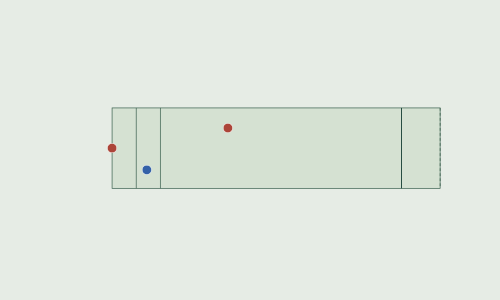
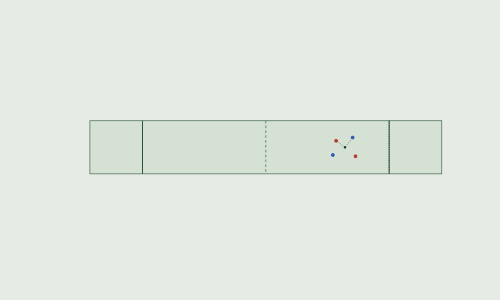
The NSA drawing shows a 52 × 6 ft court, 39 ft baseline to baseline, a 1.5 ft 10-off area, a 9 ft scoring triangle and 12 ft between lag lines. Dimensions run centre to centre on the painted lines.
How to play
Equipment
Disc
8 ×Size and equipment notes
Key size 6 in
Use four yellow discs and four black discs.
NSA discs are 6 in across, 9/16–1 in thick and at least 11.5 oz; new discs weigh 15 oz.
Cue
2 ×Size and equipment notes
Key size 6.25 ft
No metal cue part may touch the court.
The cue’s overall length may not exceed 6 ft 3 in.
Setup
- The NSA court measures 52 ft (15.85 m) by 6 ft (1.83 m). Behind each baseline is a shooting area 6.5 ft (1.98 m) deep.
- Past the baseline, mark the 10-off area 1.5 ft (0.46 m) deep and the scoring triangle 9 ft (2.74 m) high. The scoring diagram's minus-10 area is called the kitchen. (Arizona 2025 code, E-1) Each lag line lies 6 ft (1.83 m) from court centre. The lag line is also called the dead line; the space between the two lag lines is the dead zone. (NYSA rules, §1.2.3; NSA 2025 rules, Rule B-4 court drawing)
- You need 8 discs split between yellow and black, plus cues. Open the Equipment notes if you are matching a set to the NSA court.
- Courts are dressed with shuffleboard wax or loose glass beads once the line paint is dry, which is what lets the discs slide. (NSA 2025 rules, Building a Court)
- These instructions use Arizona’s playing rules on the NSA court.
Play a frame, then shoot back
A frame is played from one end of the court: the two shooters alternate discs, one at a time, until all eight discs have been shot, four each. The discs are scored where they rest, then cleared for the next frame. (NYSA rules, §2.3.4)
Each shot is a push with the cue from the shooting area toward the far scoring triangle, hard enough to pass the far lag line. You may hit any disc on the court: push your own deeper, or drive an opponent’s disc out of a zone or into the 10-off strip. Each disc scores where it ends up.
In doubles, partners stand at opposite ends: once a frame has been scored at one end, the two players at the other end shoot the next frame back toward it. (NYSA rules, §1.1.2) Under the Arizona code, singles never change ends; if only one end of the court is used, a designated pusher returns the discs after each frame. (Arizona 2025 code, D-2)
Colour lead and hammer
Decide colour by the opening lag, then start at the head of the court. Under the December 2025 Arizona code, yellow leads the opening frame and the colour lead alternates after every frame, regardless of who scored.
Hammer means the frame's last disc; the colour that does not lead a frame shoots it, so black holds the hammer in the opening frame. (NYSA rules, 3 Definitions; Arizona 2025 code, D-1b; D-3)
Score the resting discs
Score after every frame, before anyone touches a disc. A disc counts only if it lies wholly inside one zone; a disc in the 10-off strip deducts. Add each colour’s zone values, take off its 10-off discs, and add the result to that colour’s running total. Both colours can score in the same frame. Track the completed frames as well as the points; Arizona uses a scheduled finish.
Discs do not cancel each other out; if both colours have a disc scoring the same zone, both colours receive that zone's points. (NYSA rules, §1.3.1)
Arizona 12-frame game
Touching a scoring line loses the zone
| Action | Points |
|---|---|
| Disc wholly inside the 10 zone | 10 points |
| Disc wholly inside an 8 zone | 8 points |
| Disc wholly inside a 7 zone | 7 points |
| Disc wholly inside the 10-off area | -10 points |
Arizona totals all live zone values each half-frame.
How the game is won
- Highest points total after 12 frames
Tie: Play paired overtime frames so each player receives the same number of hammer shots; continue until the tie breaks.
Variants and house rules
NSA specifications
NSA supplies the court drawing, disc specifications and cue limits.
The NSA sets no playing rules of its own; every National Tournament follows the rules of its host state, so the winning target changes by state. (NSA 2025 rules, §C.1)
Use the NSA drawing for the physical court, then identify the state code on the score sheet. The Florida format below is one example.
Arizona playing code
The format shown here starts at the head, chooses colour by lag and alternates the colour lead after every frame. Scoring does not decide the next lead.
After the opening lag, the Arizona practice sequence uses the full colour set:
- After the lag, yellow shoots four practice discs and removes them; black then shoots four.
- At the halfway side change, each player takes four practice shots from the new side.
Under the Arizona code, singles never change ends; if only one end of the court is used, a designated pusher returns the discs after each frame. (Arizona 2025 code, D-2)
Building a court
Courts are built on a 4 in concrete slab, kept level to within 1/32 in across the court's 6 ft width. (NSA 2025 rules, Building a Court) Lines are painted 3/4 in to 1 in wide with sharp edges, and every court dimension is measured from line centre to line centre. (NSA 2025 rules, Building a Court)
Bumper strips are 2 in by 2 in lumber, anchored loosely so discs don't rebound hard off them. (NSA 2025 rules, Building a Court) Agree the playing code and scheduled finish before painting or throwing on a shorter layout.
Arizona 16-frame state-final qualifierScoring & finish
Arizona 16-frame state-final qualifier
Point values match Arizona 12-frame game.
How the game is won
- Highest points total after 16 frames
Florida 75-point gameScoring & finish
Florida 75-point game
Point values match Arizona 12-frame game.
Florida totals zone values each half-frame; non-walking singles cap at 12 frames.
How the game is won
- 75 points or more
Tie: If tied at or past 75, play one more full round (two in doubles); the higher score then wins, however many points it has. Replay if still tied.
Common disputes
My disc touches a zone line. Does it score?
No. Under Arizona F-1, a disc touching any scoring line earns no value for that zone. (Arizona 2025 code, Rule F-1)
A disc stopped short of the far lag line. Is it live?
No. Under Arizona D-5, remove a disc that stops short of the far lag line, leaves the court or crosses the furthest baseline; restore displaced live discs where possible. (Arizona 2025 code, Rule D-5)
Can I knock an opponent’s disc into the penalty strip?
Yes. Contacting an opponent’s disc is normal play. A live disc scores where it rests at the end of the half-frame.
Nobody scored. Who leads next?
Alternate the colour lead after the frame under Arizona rules, even if neither colour scored.
What happens after an illegal cue delivery?
Arizona requires delivery from the defined starting area in a straight, continuous forward motion. For an illegal delivery, remove the shot disc and every disc it displaced. Credit the opponent for their counting discs removed; keep the penalty against the offender for any of their own discs displaced from the kitchen. Play continues. The Head Referee or Tournament Director applies a first warning, then a second warning, then disqualification. If no court referee is assigned, the Head Referee must observe the infraction before a penalty is assessed. (Arizona 2025 code, J-1–J-3)
Is stepping over the baseline an automatic dead disc?
No. Under Arizona J-9, stepping over the baseline warrants a referee caution, not a disc-removal or scoring penalty. (Arizona 2025 code, J-9)
Who keeps score if there’s no referee?
Yellow keeps score for the first half of the game and black for the second when no scorekeepers are appointed; without a referee, players referee their own games the same way, black first. (Arizona 2025 code, H-4 and H-5)
Is this the tabletop game?
No. The bar-room game uses a long board and weights; see table shuffleboard rules or the shuffleboard chooser.
Related games
Sources
Rules used: Arizona 12-frame game. Reviewed . How we check the rules.
Publication details and rule references
- Official Rules of the Arizona Shuffleboard Association
- December 6, 2025. Retrieved .
- D-1b, p. 1, Yellow is out; D-2, p. 1; D-3, p. 2, color lead alternates; E-1, p. 2, kitchen; H-4 and H-5, p. 4; J-1–J-3, p. 5; D-6, delivery requirement; J-2 and J-4, p. 5; J-1, formal-official context; J-9, p. 5, baseline conduct; Rule A-1, p. 1; Rule D-1b, p. 1; Rule D-3, p. 2; Rule D-4, p. 2, 12-frame game; Rule D-4, p. 2, 16-frame state-final qualifying; Rule D-5, p. 2; Rule E-4, p. 2; Rule F-1, p. 3; Rules B-1 and D-1a–D-1b, p. 1; Rules E-1 and F-1, pp. 2–3
- State and District Official Shuffleboard Rules & Regulations
- Effective October 1, 2025, with amendments through October 18, 2025. Retrieved .
- A-1, p. 1; C-3.e, p. 2, 75 points; C-3.e, p. 2, non-walking singles 12 frames or 75; D-1–D-2, p. 4; D-1, p. 4, scoring diagram; D-4, p. 4, tie game
- Official Rules of the National Shuffleboard Association, Inc. (web file revised 10 February 2025)
- Revised 1997, updated January 2005, January 2023, and January 2025; web file published February 10, 2025. Retrieved .
- §B.1, p. 1, discs; §B.2, p. 1, cues; §C.1, p. 4, host-state playing rules; Building a Court, p. 3, bumper strips; Building a Court, p. 3, line width; Building a Court, p. 3, slab and tolerance; Building a Court, p. 3, wax or glass beads; Rule B-4 court drawing, p. 2; Rule B-4 court drawing, p. 2, dead lines
- Rules of Play
- Version 2.0, approved June 9, 2025. Retrieved .
- §1.1.2, Game Types, doubles; §1.2.3, p. 5, diagram key F and G; §1.3.1, p. 6, scoring discs do not cancel; §2.3.4, Shooting Order; Definitions, Frame; 3 Definitions, p. 18, hammer