
Kubb Rules
Mark the pitch, return your fallen kubbs, clear them in order and topple the king last.
- Pitch
- 26.25 × 16.4 ft(8 × 5 m)
- Players
- Two teams, any size; championship rosters run six or at least three.
- Scoring
- Clear field kubbs, baseline kubbs, then the king
- Winning
- Clear every kubb, then topple the king
Court and dimensions
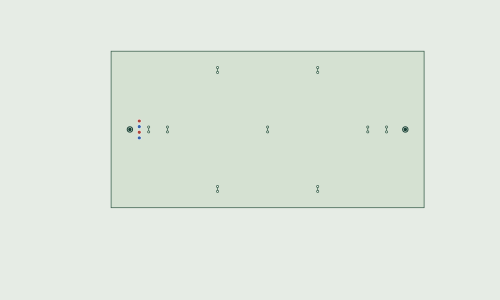
Championship pitch, 8 × 5 m


All measurements and other layouts
| Dimension | Imperial | Metric |
|---|---|---|
| Length | 26.25 ft | 8 m |
| Width | 16.4 ft | 5 m |
| End clearance | 6.56 ft | 2 m |
The marked pitch is 8 × 5 m. Current World Championship rules also keep the waiting team at least 2 m behind its baseline.
| Dimension | Imperial | Metric |
|---|---|---|
| Length | 19.69 ft | 6 m |
| Width | 16.4 ft | 5 m |
The 2003 booklet offers a 6-m length for a faster or easier game and states that the World Championship does not use it.
How to play
Equipment
King
1 ×Size and equipment notes
Key size 30 cm
Place the king at the centre and topple it only for a legal finish.
U.S. v4 permits 8 × 8 × 25 cm through 9 × 9 × 30 cm; current World Championship rules use 9.5 × 9.5 × 30 cm.
Kubb
10 ×Size and equipment notes
Key size 15 cm
Five begin on each baseline; a toppled baseline kubb returns as a field kubb.
Each kubb measures 7 × 7 × 15 cm.
Baton
6 ×Size and equipment notes
Key size 30 cm
U.S. v4 allows no player more than two batons in a round. World Championship rules allow no player more than one.
Each baton is 30 cm long and 44 mm in diameter.
Marking pin
6 ×Size and equipment notes
Current U.S. and World Championship rules mark four corners and both ends of the centre line.
Setup
- Three kinds of piece: the king is the tall block that stands at the centre; the 10 kubbs are the smaller blocks that start on the two baselines; the 6 batons are the sticks you throw.
- Mark a pitch 8 m long and 5 m wide. Put 6 pins at the corners and centre-line ends. Stand the king at the centre, then place half of the 10 kubbs along each baseline.
- Under U.S. v4, space the five baseline kubbs no closer than one baton length from the corner stakes, with the baseline running through their centres.
- Leave space behind each baseline for the waiting team. The diagram’s pitch dimensions exclude that clearance.
Choose the opening team
A player from each team throws a baton toward the king at the same time. The closer legal baton wins the choice of first throw or baseline; the other team gets the remaining choice. Knocking the king down does not win this opening toss.
Return your kubbs, then throw batons
Every turn has the same shape: the attacking team throws its batons, then the other team gathers the kubbs that were toppled, throws them into the attackers' half, and the attackers stand them up as field kubbs before throwing batons again. Turns alternate until one team has toppled every opposing kubb and then the king. (U.S. rules v4, §I.D)
- Throw your batons from behind your baseline at the kubbs standing on the far baseline. Under U.S. v4, throw each baton underarm; it must not go more than 30 degrees off the vertical plane and must at least start rotating end over end, except a non-rotating throw is legal from the advantage line at field kubbs. (U.S. rules v4, §II.B.1) Current World Championship rules require your feet to start the throw inside the sidelines and fully behind the throwing line. (World Kubb rules, Throw the sticks)
- When your batons are spent, the other team collects the kubbs you toppled and throws them underarm from its baseline into your half.
- You stand each of those kubbs up where it stopped. They are now field kubbs, and they are the other team’s first targets.
- The other team throws its batons: at the field kubbs first, then at your baseline kubbs, and, once every one of your kubbs is down, at the king.
- Then it is your turn again, starting with the kubbs the other team toppled on your side.
U.S. National v4 opens with two batons for the starting team, four for its opponent, then six on later turns. No player throws more than two batons in a round.
Raise the returned kubbs
Under U.S. v4, defenders pivot each incoming kubb upright over an end edge, where it stopped, without twisting the piece.
A field kubb that can be raised in bounds must be raised in bounds. (U.S. rules v4, §II.D.3)
Under U.S. v4, raise an incoming leaning kubb on the end closest to the field. If that end is out of bounds, raise the supporting kubb first, lower the leaning kubb back to its former position, then raise it in bounds. (U.S. rules v4, §II.D.5(d))
Use the advantage line
If your opponent leaves field kubbs standing in your half, draw an imaginary line through the centre of the one closest to the centre line, parallel to your baseline. You may throw batons from behind that advantage line. Throw incoming kubbs and any king attempt from your original baseline. A baseline kubb toppled while an opposing field kubb still stands is raised in its previous place.
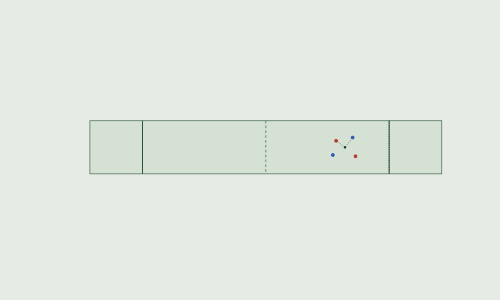
The field kubbs in the far half are your first targets.
Clear the field, then the king
Clear the opposing field kubbs before the baseline kubbs. Kubb has no running point total.
U.S. National Championship v4
Move forward for kubbs; return for the king
Clear field kubbs, baseline kubbs, then the king.
How the game is won
- Topple the king from the baseline after clearing every opposing kubb. Early loss: Topple the king early with a baton or thrown kubb
Variants and house rules
U.S. National v4
Team size: Two teams, any size; championship rosters run six or at least three. House games have no minimum. The instructions above follow this format’s opening and baton allocation.
World Championship
Team size: Six per team; a shorthanded team throws one baton per player. Teams may agree to use the full set from the start or the graduated opening; the graduated opening applies if they cannot agree. Distribute the batons evenly, with no player throwing more than a baton in a round.
After a second miss, the World Championship booklet lets the defending team place a kubb that lands outside their half anywhere on the pitch, provided it stays at least one baton length from the king or a corner stake.
Historical shorter pitch
The older World Championship booklet offers a pitch 6 m long and 5 m wide for a faster or easier game. The booklet says the championship does not use this variation. The current World Championship page allows skill-scaled field sizes without selecting this exact one.
Casual team sizes
For a casual game with fewer than six a side, use the World Championship's scaling: in a six-baton round, throw one baton per player and no more.
Current World ChampionshipScoring & finish
Current World Championship
Clear field kubbs, baseline kubbs, then the king.
How the game is won
- Topple the king from the baseline after clearing every opposing kubb. Early loss: Topple the king early with a baton or thrown kubb
Common disputes
Two thrown kubbs landed touching. Do we stack them?
No. Current World Championship rules bar stacking or towers of thrown kubbs. Under U.S. v4, a kubb that lands on top of another is lowered directly to the pitch beside it. The championship's own booklet lists a three-kubb tower as a variation it does not use. (World Kubb rules, General; U.S. rules v4, §II.D.6; World Kubb rulebook, p. 2)
Which fallen kubbs do we throw in?
Your team gathers its own kubbs that the opponent toppled on the previous turn. Throw those pieces into the opponent’s half, where the opponent raises them as field kubbs.
A field kubb landed outside. What happens?
Under U.S. v4, an invalid kubb gets a rethrow. If it still cannot be raised in bounds, it becomes a punishment kubb. For a U.S. punishment kubb, the defenders choose a position in their own half at least one baton length (30 cm) from the king and every pitch-marking stake. (U.S. rules v4, §II.D.11)
A baton spun sideways or crossed the line. Is it replayed?
No. That breaks the legal-throw rule above.
Under U.S. v4, an illegal baton is spent and every affected kubb returns to its prior position. (U.S. rules v4, §II.B.1) Under current World Championship rules, a helicopter throw or overstep is spent and affected kubbs return to their prior positions. (World Kubb rules, Throw the sticks)
A kubb leans on another piece. Is it down?
Under U.S. v4, pause play to test a struck kubb leaning on another piece. The defenders move the support just enough to see whether the kubb falls, without touching the leaning kubb, then restore the pieces as closely as possible. If it would fall, count it as toppled for the rest of the phase. (U.S. rules v4, §II.B.9)
The wind blew a kubb over. Does it count?
No. Wind, uneven ground, or an accidental jostle does not topple a kubb; put it back as it stood. A kubb that a legal hit knocks down still counts as toppled even if it ends up standing on one end. (U.S. rules v4, Glossary)
My baton knocked over a kubb on our own side. Does that count?
No. Under U.S. v4, if your baton hits a field kubb still standing in your own half, every kubb it disturbs there or in the opponent's half is reset (including the king, on a game-ending throw), and the baton is spent. (U.S. rules v4, §II.B.11)
A thrown kubb knocked over a standing kubb. What happens to it?
A thrown kubb that topples an already-raised field kubb has it raised again where it comes to rest. One that topples a baseline kubb has the baseline kubb stood back up, once every field kubb has been thrown, and it stays a baseline kubb. (World Kubb rulebook, p. 4; U.S. rules v4, §II.C.4(a))
Can we attack the king from the advanced line?
No. The advanced line applies to baton attacks on kubbs. Kubb throws and king attacks remain at your baseline.
The king fell before the kubbs were clear. Can we replay it?
No. Toppling the king before every opposing kubb is down loses the game, whether a baton or a thrown kubb hits it. (U.S. rules v4, §I.D; World Kubb rules, Throw against the King)
Related games
Sources
Rules used: U.S. National Championship v4. Reviewed . How we check the rules.
Publication details and rule references
- U.S. National Kubb Championship Rules
- Version 4.0. Retrieved .
- §I.B–C, p. 2; §I.B, p. 2; §I.C–D, p. 2; §I.C, p. 2; §I.D, p. 2; §I.D, p. 2 and Glossary, p. 12; §I.D, Play Overview, p. 2; §II.A.1–5, pp. 4–5; §II.B.2/B.5 and §II.C.1/C.5–6, pp. 5–7; §II.B.1, p. 5; §II.B.11, p. 6; §II.B.5, p. 6; §II.B.9, p. 6, struck kubb supported by another piece; §II.C.4(a), p. 6; §II.D.11, p. 9, punishment-kubb placement; §II.D.3, p. 7; §II.D.5(d), p. 8, raising a leaning incoming kubb; §II.D.6, pp. 8–9; Glossary, p. 12 and §II.B.10, p. 6; II.A.4, pp. 4–5; II.B.5 and II.C.1, p. 6; II.B.2–4, p. 5; II.C.1, p. 6; phase breakdown, p. 4
- Rules in the WC
- Undated current World Championship web rules. Retrieved .
- General; General, field marking; General, king dimensions; General, reduced-team baton allocation; General, team and baton allocation; How to start the game; Throwing in fieldkubbs; Throw the sticks; Throw against the King; Throw the sticks, helicopter and overstep remedies; Throw the sticks, waiting-team position; Throwing and raising kubbs
- Kubb: A Game for All. World Championship Rules
- English translation 1998, updated 2003. Retrieved .
- p. 2, Game Variations; pp. 3–4