
Croquet Rules
Choose the code your set uses, then play the complete MCA 2018 BASE nine-wicket game.
Choose the game you have
- Court
- 100 × 50 ft(30.48 × 15.24 m)
- Players
- 2 or 4 players in singles or doubles
- Scoring
- Score each ball's full course in order
- Winning
- Both team balls finish, or lead after final timed turns
Court and dimensions
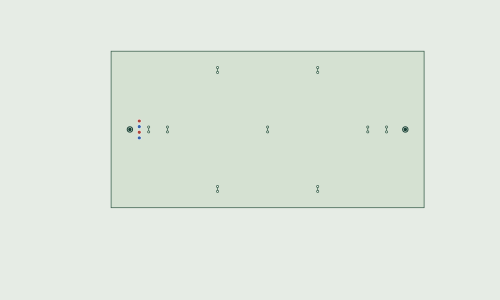
MCA full court, 100 by 50 ft


All measurements and other layouts
| Dimension | Imperial | Metric |
|---|---|---|
| Length | 100 ft | 30.48 m |
| Width | 50 ft | 15.24 m |
| Stake from end | 6 ft | 1.83 m |
| Wicket 1 from stake | 6 ft | 1.83 m |
| Wicket 2 from stake | 12 ft | 3.66 m |
| Side wicket from wicket 2 | 16 ft | 4.88 m |
| Side wicket from side | 6 ft | 1.83 m |
| Side wicket from end | 34 ft | 10.36 m |
MCA Rule 1 and Diagram 1 set the full double diamond. The 34 ft side-wicket position is derived from the printed 6 ft, 12 ft and 16 ft steps.
| Dimension | Imperial | Metric |
|---|---|---|
| Length | 50 ft | 15.24 m |
| Width | 25 ft | 7.62 m |
| Stake from end | 3 ft | 0.91 m |
| Wicket 1 from stake | 3 ft | 0.91 m |
| Wicket 2 from stake | 6 ft | 1.83 m |
| Side wicket from wicket 2 | 8 ft | 2.44 m |
| Side wicket from side | 3 ft | 0.91 m |
| Side wicket from end | 17 ft | 5.18 m |
Half of the MCA full court, scaled in proportion as USCA's court section directs. Its 3 ft gaps fall under the 4 ft floor MCA asks players to keep when 6 ft is not possible, so it is not an official minimum.
How to play
Equipment
Wicket
9 ×Size and equipment notes
Key size 3.75 in
Two paired wickets stand before each stake, four form the diamonds and one is centred.
MCA official wickets have a 3.75 in opening; keep casual wickets uniform.
Stake
2 ×Size and equipment notes
The near stake is the start and finish; the far stake turns the course.
Ball
4 ×Size and equipment notes
Key size 3.63 in
The base game uses blue, red, black and yellow; six-ball play adds green and orange.
MCA balls are 3 5/8 in across and weigh 16 oz.
Mallet
1 × per playerSize and equipment notes
Strike with an end face. MCA forbids pushing the ball.
Four croquet codes
Most boxed garden sets use nine wicket. Club courts may use American six wicket, Association or Golf Croquet. Their layouts overlap, but their turns and winning procedures do not.
| Code | Court and equipment | How play differs |
|---|---|---|
| Nine wicket | Court and equipment100 ft (30.48 m) by 50 ft (15.24 m); 9 wickets and 2 stakes | How play differsFixed colour turns. MCA BASE gives a choice after a roquet; both team balls must finish. |
| American six wicket | Court and equipment105 ft (32 m) by 84 ft (25.6 m); 6 hoops and one centre peg | How play differsFixed colour turns, persistent deadness and a required croquet stroke after a legal roquet. |
| Association | Court and equipmentThe standard six-hoop boundary and centre-peg setting | How play differsSides alternate turns. In singles, the player may choose either side ball. |
| Golf | Court and equipmentThe standard six-hoop boundary and centre-peg setting | How play differsOne stroke per turn in colour order. Both sides contest the same hoop. |
The instructions below use MCA BASE nine-wicket rules.
Setup
- Mark the full 100 by 50 ft boundary rectangle and measure it from inside edge to inside edge.
- Keep the grass short: MCA recommends 1 inch or less, so less than an inch of the ball sits below the grass. You do not need paint: corner flags or stakes may mark the boundary instead, and where you do paint or chalk a line, the boundary is its inside edge.
Mark each wicket and stake from the measured court page.
A coin toss decides who goes first: the winning side chooses to play first and third with blue and black, or second and fourth with red and yellow. Singles players control a pair of balls; doubles players control a ball each. Start each ball with its front edge at least 3 ft from wicket 1. (MCA rulebook, Rule 6B)
Follow the complete course
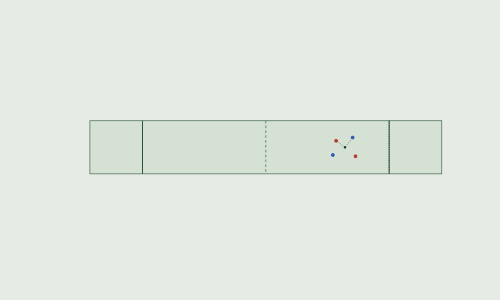
Follow MCA Diagram 2: points 1–2 are the near pair; 3 the near side wicket; 4 the centre; 5 the far same-side wicket; 6–7 the far pair; 8 the turning stake; 9–10 the far pair in reverse; 11 the skipped far side wicket; 12 the centre in reverse; 13 the skipped near side wicket; 14–15 the near pair in reverse; 16 the finishing stake. Each wicket and stake counts only in that order and direction. A ball scores its wicket only once it comes to rest clear of the playing side; one that passes through and rolls back has not scored it.
Once a ball runs its last wicket, see Rovers below for its two remaining options.
Take a turn
MCA 2018 BASE plays the balls in the order blue, red, black, yellow, one player at a time. The player in play, the striker, gets one stroke to start a turn. If that stroke earns no bonus, the turn ends and the next colour plays; a turn also ends once the striker has no bonus stroke left or finishes the course.
Most turns in a first game are one stroke: aim at your next wicket, then hand play on.
Earn bonus strokes
Scoring a wicket or the turning stake earns one bonus stroke; hitting another ball, a roquet, earns two bonus strokes instead, replacing any bonus already earned. Two is the most a striker ever holds at once. (MCA rulebook, Rule 10)
A wicket earns a stroke and hitting another ball earns two, so a turn runs on for as long as you keep scoring or hitting. Two terms cover almost everything that follows: a roquet is hitting another ball with yours, and a croquet shot is a stroke you then play with your ball touching the one you hit.
Plan the stroke after a roquet
For the first of the two roquet strokes, choose one of four options: play within a mallet-head, the length of the mallet's head, of the ball you hit; hold your ball with your foot or hand against it, a foot shot or hand shot; play a croquet shot in contact with it without holding your ball; or play from where your ball stopped. Then play an ordinary continuation stroke from wherever your ball ends up. (MCA rulebook, Rule 10)
Tell the other side which roquet choice you are taking before you move a ball.
After a legal MCA BASE roquet, you may play the first bonus shot from where your striker ball stopped. For example, blue hits an eligible red ball and stops facing its next wicket: blue can play from there, then use its continuation from the new resting place. If blue scores its wicket on that first bonus shot, the wicket bonus replaces the unused continuation; the bonuses do not accumulate.
Scoring two wickets in a single stroke earns two bonus shots, not one; scoring course point 7 and the turning stake together in one stroke also earns two, matching the normal two-shot cap rather than adding a third.
Choose the placement that serves your next shot before moving the striker ball. Taking contact croquet can move the other ball as well; playing from where you stopped preserves that position until the next stroke. Track which ball you have roqueted during the turn.
Under BASE, you may earn a roquet bonus off a given ball only once before you score your next wicket; hitting it again earns nothing but is not a fault, and MCA calls that ball dead to you until you score that wicket or your next turn begins. (MCA rulebook, Rule 10) That is the only deadness in BASE play; the carry-over version belongs to the Advanced rules in the variants below.
Boundaries and errors
A ball more than halfway past the inner boundary edge is out; return it 9 in perpendicular to the crossing point and the turn ends. If the striker just roqueted a ball that remains in bounds, place the striker in contact with it or up to one mallet-head away. Every ball less than one mallet length from the boundary must be brought in to that margin, except a striker that still has an extra stroke. (MCA rulebook, Rule 12)
A ball not through wicket 1 and a ball already through it are dead to each other; contact restores the balls and ends the turn. (MCA rulebook, Rule 6D) Balls that have both yet to clear the first wicket may touch without a roquet; unless the striker runs its wicket, the turn ends with the balls left where they stopped.
If the mallet hits a ball other than the striker ball, the turn ends and all moved balls return. (MCA rulebook, Rule 8) Out-of-turn play has no penalty: restore moved balls and continue with the correct ball. (MCA rulebook, Rule 7)
A swing that misses your ball entirely still counts as your shot and ends your turn unless you have a bonus stroke left; if a practice swing strikes the ball, replace it and take the shot again without penalty. (MCA rulebook, Rule 8)
Complete the course
Run each wicket and hit each stake in course order. The finishing stake retires that ball; the standard team game continues until both side balls have finished, unless the timed finish applies.
Rovers
Once a ball runs every wicket, its side may keep it in play as a rover instead of sending it to the finishing stake. A rover may hit each other ball once per turn for bonus strokes but scores no further wicket points, and any player, including an opponent, can retire it by hitting the finishing stake.
MCA 2018 BASE four-ball game
Out to the turning stake, then home
| Action | Points |
|---|---|
| Run the next wicket in order and directionScores one point and earns one bonus stroke. | 1 point |
| Roquet an eligible ballScores no point and replaces the remaining allowance with two bonus strokes. | 0 points |
| Hit the turning or finishing stake in orderThe turning stake earns a bonus stroke; the finishing stake retires that ball. | 1 point |
Score each ball's full course in order.
How the game is won
- Both team balls complete the 16-point course and hit the finishing stake
- After 60 minutes in singles, finish the turn and give every remaining ball a last turn
- After 70 minutes in doubles, finish the turn and give every remaining ball a last turn
Tie: After timed last turns, play full rounds until a side leads or stakes out both balls.
Variants and house rules
MCA BASE and USCA Basic
MCA BASE governs the instructions above. Current USCA Basic uses similar turn choices, but its boundary placement differs: USCA Basic returns an out ball one mallet length, stated as 36 in, rather than MCA's 9 in. (USCA rule synopsis, The Boundaries)
Advanced rules
Advanced play uses every advanced rule together, not as separate options: carry-over deadness, clearing deadness when the opponent scores the first wicket after the turning stake (course point 9), the blocked-wicket rule, wiring and lift, and advanced rover play. (MCA rulebook, Advanced Rules intro)
Under BASE rules, a second hit on the same ball before the striker's next wicket earns no bonus and no penalty; that ball is eligible again next turn. (MCA rulebook, Rule 10) Under MCA Advanced carry-over deadness, a dead-ball roquet ends the turn and restores all balls to their pre-stroke positions. (MCA rulebook, Advanced Rule A-01)
Proportional half court
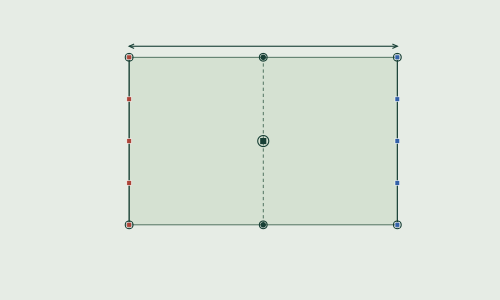
The half court is 50 ft (15.24 m) by 25 ft (7.62 m), scaled from the full court in proportion. Its gaps are below MCA’s preferred 6 ft (1.83 m) spacing; use it for casual play, or see the court page for a size that keeps the minimum.
Six balls and poison
2–6 players with one ball each; green and orange follow yellow. A finishing ball wins that individual format.
Under USCA Option 7, poison removes an opponent ball it roquets; poison is removed if an opponent roquets it or it fully runs a wicket, and no roquet bonus is earned. (USCA rule synopsis, Challenging Optional Rules) Poison is optional USCA play, not part of MCA BASE.
MCA 2018 six-ball cutthroatScoring & finish
MCA 2018 six-ball cutthroat
| Action | Points |
|---|---|
| Run the next wicket in order and directionScores one point and earns one bonus stroke. | 1 point |
| Roquet an eligible ballScores no point and gives the same two-stroke choice as BASE play. | 0 points |
| Hit the turning or finishing stake in orderThe finishing stake ends that player's course. | 1 point |
Each player advances one ball through the course.
How the game is won
- One player's ball completes the course and hits the finishing stake
Common disputes
Does a ball reaching the finishing stake win?
Only in the individual cutthroat format. A standard side must finish both balls.
They knocked my ball through my wicket. Does it count?
Yes. Your side scores that wicket point but earns no bonus stroke for it; MCA calls this a peel. (MCA rulebook, Rule 9)
It went through backwards. Do I lose a point?
Running a wicket out of order or in the wrong direction scores nothing: not a point gained, and not one lost. (MCA rulebook, Rule 9)
Can I put my foot on my ball?
Yes, right after a legal roquet: on the first bonus stroke you may hold your ball steady with your foot or hand while you hit it, sending the other ball away. (MCA rulebook, Rule 10; USCA rule synopsis, Bonus Shots)
Must I take croquet after a roquet?
No. MCA BASE gives four choices for the first bonus stroke. The mandatory croquet stroke belongs to American six wicket.
Is a ball still dead next turn?
Under BASE, no. Carry-over deadness applies only if your group plays under Advanced rules.
Can I send their ball out of bounds on the croquet shot?
On the croquet shot you may send either ball out of bounds, your own or the one you hit; either way your turn ends, and any ball that crossed the boundary is marked in 9 inches. (MCA rulebook, Rule 12)
What happens when a ball leaves the court?
See Boundaries and errors above: the ball comes back in bounds, and the turn usually ends.
Can I straighten a leaning wicket?
Ask permission before adjusting or resetting a wicket or stake; MCA treats this as conduct, not a stated foul remedy. (MCA rulebook, Code of Conduct)
Does the half court count as official?
No. MCA does not publish it; it is a proportional copy of the full court, and its gaps sit below MCA’s preferred spacing.
Related games
Sources
Rules used: MCA 2018 BASE four-ball game. Reviewed . How we check the rules.
Publication details and rule references
- Official Nine-Wicket Croquet Rulebook: Backyard Croquet Rules, 2018 edition
- 2018 edition. Retrieved .
- Advanced Rule A-01, p. 15; Advanced Rules intro, p. 15; A-02–A-05, pp. 15–16; Code of Conduct, p. 23; Diagram 1, p. 7; Diagram 2, p. 10; Diagram 4, p. 19, corner peg layout; Rule 1 and Diagram 1, pp. 6–7; Rule 1, p. 6, boundary marking; Rule 1, p. 6, court spacing; Rule 1, p. 6, four-foot minimum; Rule 1, p. 6, grass height; Rule 1, p. 6, reduced-court guidance; Rule 1, p. 6; Rule 1, The Court, pp. 6–7; Rule 10 Exceptions, p. 12, two wickets; Rule 10, p. 11, BASE deadness; Rule 10, p. 12, foot shot; Rule 10, p. 12, four first-bonus choices; Rule 10, pp. 11–12; Rule 10, pp. 11–12, bonus shots; Rule 10, pp. 11–12, deadness under BASE; Rule 10, pp. 11–12, options after a roquet; Six-Ball Croquet, p. 20; Special Scenarios, p. 21; Rule 12, p. 13, croquet shot out of bounds; Rule 12, pp. 12–13; Rule 13, p. 13, rovers; Rule 14, p. 13, last turns and tie rounds; Rule 14, p. 13, timed doubles; Rule 14, p. 13, timed singles; Rule 2 and Diagram 1, pp. 6–7; Rule 2, p. 6; Rule 3, p. 6; Rule 4, p. 6; Rule 5, p. 8; Rule 5, p. 8, playing order and the striker's turn; Rule 6A, p. 8, coin toss; Rule 6B, p. 8; Rule 6D, p. 8; Rule 7, p. 9; Rule 8, p. 9; Rule 8, p. 9, missed swing; Rule 9, p. 10, wrong order; Rule 9, p. 10; Special Scenarios, p. 21, peel; Rule 9, p. 11, wicket scored; Rules 1–14, pp. 6–16; Diagrams 1–3, pp. 7, 10–11; Rules 10–11, pp. 11–12; Rules 3 and 6, pp. 6, 8; Rules 3 and 6A, pp. 6, 8; Rules 3, 5 and 6, pp. 6, 8; Rules 5 and 10, pp. 8, 10–11; Rules 5 and 10; Diagram 2, pp. 8, 10–11; Rules 5 and 14, pp. 8, 13; Rules 5, 9–10 and Diagram 2, pp. 8, 10–11; Rules 9–10, pp. 10–11
- Nine Wicket Backyard Croquet Rules
- Undated live page. Retrieved .
- Basic Rules, Bonus Shots, The Boundaries, Challenging Optional Rules; Bonus Shots, foot shot or hand shot; Challenging Optional Rules, Option 7: Poison; The Boundaries, Basic Rules; The Court, proportional scaling instruction; The Mallets
- The Official Rules of the United States Croquet Association: American Six Wicket Croquet, Revised 2024
- Revised 2024. Retrieved .
- Court and equipment, pp. 25–29; Rules 1–13, PDF pp. 30–82
- Laws of Association Croquet, 7th Edition
- 7th Edition, approved January 24, 2021. Retrieved .
- Laws 1–5 and Diagram 1, PDF pp. 8–14
- The WCF Rules of Golf Croquet, Sixth Edition, February 2022
- Sixth Edition, February 2022. Retrieved .
- Rules 1.1–1.4, 2.1–2.3; Diagram 1, PDF p. 4