
Nine-Wicket Croquet Court Layout
Place every wicket and stake from the MCA diagram, with a coordinate table and a proportional half court.
Layout and dimensions
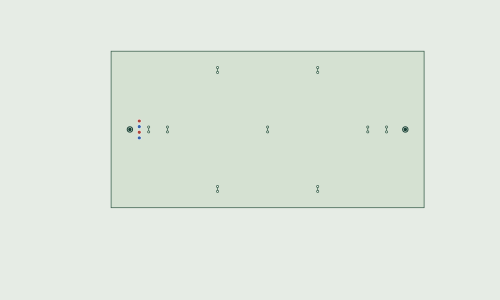
MCA full court, 100 by 50 ft


All measurements and other layouts
| Dimension | Imperial | Metric |
|---|---|---|
| Length | 100 ft | 30.48 m |
| Width | 50 ft | 15.24 m |
| Stake from end | 6 ft | 1.83 m |
| Wicket 1 from stake | 6 ft | 1.83 m |
| Wicket 2 from stake | 12 ft | 3.66 m |
| Side wicket from wicket 2 | 16 ft | 4.88 m |
| Side wicket from side | 6 ft | 1.83 m |
| Side wicket from end | 34 ft | 10.36 m |
MCA Rule 1 and Diagram 1 set the full double diamond. The 34 ft side-wicket position is derived from the printed 6 ft, 12 ft and 16 ft steps.
| Dimension | Imperial | Metric |
|---|---|---|
| Length | 50 ft | 15.24 m |
| Width | 25 ft | 7.62 m |
| Stake from end | 3 ft | 0.91 m |
| Wicket 1 from stake | 3 ft | 0.91 m |
| Wicket 2 from stake | 6 ft | 1.83 m |
| Side wicket from wicket 2 | 8 ft | 2.44 m |
| Side wicket from side | 3 ft | 0.91 m |
| Side wicket from end | 17 ft | 5.18 m |
Half of the MCA full court, scaled in proportion as USCA's court section directs. Its 3 ft gaps fall under the 4 ft floor MCA asks players to keep when 6 ft is not possible, so it is not an official minimum.
Marking out the court
Square the marked boundary first. Measure the rectangle from the inside edge of one boundary to the inside edge opposite it, then place the stakes and wickets inward. The Layout control beside the drawing switches between the full MCA court and the proportional half court; the measurement tables under the drawing list both.
Full MCA court
The MCA court is 100 ft (30.48 m) by 50 ft (15.24 m). Place each stake on the centre line 6 ft in from its end boundary. Place the paired wickets 6 ft and 12 ft from each stake on the centre line.
From each second wicket, go 16 ft toward the centre and set two side wickets 6 ft in from the side boundaries. Place the ninth wicket at the exact centre of the court.
The coordinate table below places every wicket and stake.
Coordinate table
Each row gives a wicket or stake’s distance from the left boundary and from the near end, for the full court and its proportional half-scale copy.
The near end is the end with the starting stake, where the balls are drawn. Stand at that stake facing up the court: the left boundary is the long side on your left. On a phone the drawing shows the near end at the bottom, so left is left; on a wider screen the drawing turns a quarter turn, the near end sits at the left, and the left boundary is the top edge.
| Position | From the left boundary | From the near end |
|---|---|---|
| Starting / finishing stake | 25 ft (7.62 m) | 6 ft (1.83 m) |
| Wicket 1 | 25 ft (7.62 m) | 12 ft (3.66 m) |
| Wicket 2 | 25 ft (7.62 m) | 18 ft (5.49 m) |
| Near side wicket, left | 6 ft (1.83 m) | 34 ft (10.36 m) |
| Near side wicket, right | 44 ft (13.41 m) | 34 ft (10.36 m) |
| Centre wicket | 25 ft (7.62 m) | 50 ft (15.24 m) |
| Far side wicket, left | 6 ft (1.83 m) | 66 ft (20.12 m) |
| Far side wicket, right | 44 ft (13.41 m) | 66 ft (20.12 m) |
| Far wicket 2 | 25 ft (7.62 m) | 82 ft (24.99 m) |
| Far wicket 1 | 25 ft (7.62 m) | 88 ft (26.82 m) |
| Turning stake | 25 ft (7.62 m) | 94 ft (28.65 m) |
| Position | From the left boundary | From the near end |
|---|---|---|
| Starting / finishing stake | 12.5 ft (3.81 m) | 3 ft (0.91 m) |
| Wicket 1 | 12.5 ft (3.81 m) | 6 ft (1.83 m) |
| Wicket 2 | 12.5 ft (3.81 m) | 9 ft (2.74 m) |
| Near side wicket, left | 3 ft (0.91 m) | 17 ft (5.18 m) |
| Near side wicket, right | 22 ft (6.71 m) | 17 ft (5.18 m) |
| Centre wicket | 12.5 ft (3.81 m) | 25 ft (7.62 m) |
| Far side wicket, left | 3 ft (0.91 m) | 33 ft (10.06 m) |
| Far side wicket, right | 22 ft (6.71 m) | 33 ft (10.06 m) |
| Far wicket 2 | 12.5 ft (3.81 m) | 41 ft (12.5 m) |
| Far wicket 1 | 12.5 ft (3.81 m) | 44 ft (13.41 m) |
| Turning stake | 12.5 ft (3.81 m) | 47 ft (14.33 m) |
Proportional half court
The smaller reference is 50 ft (15.24 m) by 25 ft (7.62 m), scaled from the MCA layout in proportion. USCA's court section states only proportional scaling, with no numeric floor; MCA asks for 6 ft between the paired wickets and stakes, or at least 4 ft where space is tight. (MCA rulebook, Rule 1; USCA rule synopsis, The Court) Neither body publishes this exact size, and its 3 ft (0.91 m) gaps fall under MCA’s preferred 6 ft (1.83 m) spacing.
The smallest proportional court that still keeps MCA's 4 ft minimum gap is two-thirds scale: about 66.7 by 33.3 ft, since two-thirds of the printed 6 ft gap is exactly 4 ft.
MCA also prints an 84 by 50 ft corner-stake layout cut from a six-wicket court, for sites too tight for the full 100 by 50 ft rectangle.
Check the layout before play
- Lay out the boundary with temporary markers and compare its diagonals before pressing wickets into the turf.
- Mark the centre line, then measure each end from its own boundary.
- Check each wicket and stake against the coordinate table before fixing its position.
Start and follow the course
See the rules page for where each ball starts.
Play runs the complete course in order; use the table above to place every wicket and stake before the first turn.
Ball order
Blue, red, black, yellow remains the playing order. Skip a ball after it reaches the finishing stake. A six-ball cutthroat game continues with green and orange.
Scoring context
The full croquet rules cover how each wicket and stake scores, the roquet choices, boundaries, team finish and Advanced rules.
Wicket and stake positions
Which edge of the boundary do I measure?
Use the inside edges of the marked rectangle. Stakes and wickets sit inward from those lines.
Which stake is the finish?
The stake behind the starting area is the finishing stake. The ball hits the far stake while going out, reverses the course and returns to finish.
Related games

Sources
Rules used: MCA 2018 BASE four-ball game. Reviewed . How we check the rules.
Publication details and rule references
- Official Nine-Wicket Croquet Rulebook: Backyard Croquet Rules, 2018 edition
- 2018 edition. Retrieved .
- Diagram 1, p. 7; Diagram 4, p. 19, corner peg layout; Rule 1 and Diagram 1, pp. 6–7; Rule 1, p. 6, court spacing; Rule 1, p. 6, four-foot minimum; Rule 1, p. 6, reduced-court guidance; Rule 1, p. 6
- Nine Wicket Backyard Croquet Rules
- Undated live page. Retrieved .
- The Court, proportional scaling instruction