
Horseshoes Rules
Set fixed stakes, pitch complete innings and score the nearest live shoes under the chosen NHPA method.
- Stake fronts
- 40 ft(12.19 m)
- Players
- Singles or doubles under NHPA rules
- Scoring
- Cancel ringers, then score the closest live shoe
- Winning
- Reach or pass the agreed point limit
Court and dimensions
Full distance, 40-ft stakes and 37-ft foul line


All measurements and other layouts
| Dimension | Imperial | Metric |
|---|---|---|
| Stake distance | 40 ft | 12.19 m |
| Pitching box | 6 ft | 1.83 m |
| Pit length | 72 in | 182.9 cm |
| Pit width | 36 in | 91.4 cm |
| Stake height | 15 in | 38.1 cm |
| Stake lean | 3 in | 7.6 cm |
| Foul line from stake | 37 ft | 11.28 m |
| Playing area length | 46 ft | 14.02 m |
| Playing area width | 6 ft | 1.83 m |
| Side buffer | 2 ft | 0.61 m |
| End buffer | 2 ft | 0.61 m |
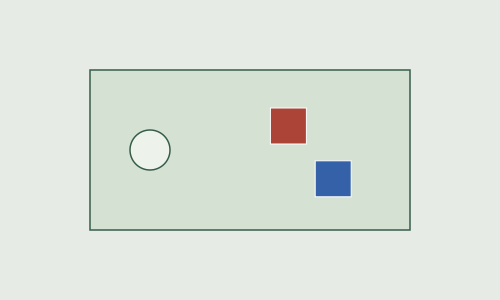
The pit may be 43–72 in long and 31–36 in wide; this drawing uses the legal maxima.
| Dimension | Imperial | Metric |
|---|---|---|
| Stake distance | 40 ft | 12.19 m |
| Pitching box | 6 ft | 1.83 m |
| Pit length | 72 in | 182.9 cm |
| Pit width | 36 in | 91.4 cm |
| Stake height | 15 in | 38.1 cm |
| Stake lean | 3 in | 7.6 cm |
| Foul line from stake | 27 ft | 8.23 m |
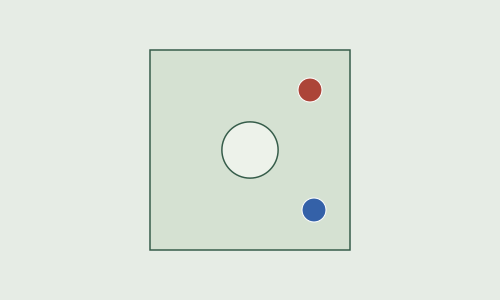
The 27-ft foul line is measured from the opposite stake; the stakes stay 40 ft apart.
| Dimension | Imperial | Metric |
|---|---|---|
| Stake distance | 40 ft | 12.19 m |
| Pitching box | 6 ft | 1.83 m |
| Pit length | 72 in | 182.9 cm |
| Pit width | 36 in | 91.4 cm |
| Stake height | 15 in | 38.1 cm |
| Stake lean | 3 in | 7.6 cm |
| Foul line from stake | 20 ft | 6.1 m |
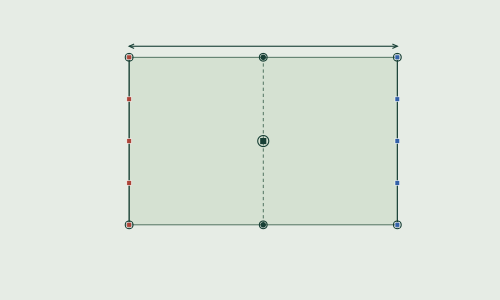
Marked at the exact midpoint between the stakes.
How to play
Equipment
Horseshoe (singles game)
4 ×Size and equipment notes
Key size 7.63 in
Each contestant pitches two shoes.
Maximum length is 7-5/8 in; maximum width is 7-1/4 in and maximum weight is 2 lb 10 oz.
Horseshoe (doubles game)
8 ×Size and equipment notes
Each of four contestants uses two shoes; partners stand at opposite ends.
Stake
2 ×Size and equipment notes
Key size 15 in
Stake fronts are 40 ft apart at platform level.
Stake tops stand 14–15 in above the platforms and lean 3 in toward each other.
Backboard
2 ×Size and equipment notes
Place one at least 3 ft behind each stake, at least 1 ft high and spanning the pit width.
Setup
- Keep the stake fronts 40 ft (12.19 m) apart. Build a 6 ft (1.83 m) square pitcher’s box at each end. The drawing uses the maximum legal pit length of 72 in (182.9 cm) and width of 36 in (91.4 cm).
- Everyone pitches from behind a foul line marked in front of the pitching platform. Which line a contestant uses depends on their NHPA division; the stakes themselves never move. Mark the foul line from the opposite stake's front; do not move stakes for a shorter line.
- Open Men and Senior Men use the 37-ft line. Women, Junior Boys/Girls (18 and under), Elder Men (70+) and exempted men under 70 use the 27-ft line.
- Junior Cadets (12 and under) use the 20-ft line, marked at the stakes' exact midpoint.
- A singles game uses 4 shoes. Doubles uses 8, with partners at opposite ends.
Pitch the shoes, then change ends
An inning has four shoes. The first contestant delivers both shoes underhand from one platform within 30 seconds; the opponent then does the same. The prior scorer pitches first next; after a blank inning, the last pitcher starts next. Walk to the far pit after the inning, agree the score and pitch back.
Measure before collecting
Wait until the inning is complete before walking to the scoring pit, except to remove a foul shoe. Agree each shoe’s value before lifting it. If you cannot resolve a close call, ask the judge to measure it; players may carry measuring tools and settle clear calls themselves.
Leave shoes in place until both players agree the inning score.
Ringers, close shoes and cancellation
A ringer is a live shoe that lands around the stake so that a straightedge laid across its open ends clears the stake. Any other live shoe near the stake is scored by its distance from the stake. A game is a run of innings that continues until a contestant reaches the agreed point total or the agreed number of shoes. (NHPA judging page, Judging Ringers & Close Shoes)
Under NHPA cancellation, score each inning in two passes. First, opposing ringers cancel each other. Then compare what is left: only the closest live shoe to the stake scores, and only if it lies within the scoring distance in the table; a second shoe from the same contestant scores as well if it is the next closest.
NHPA cancellation, point limit
A ringer must clear the straightedge
| Action | Points |
|---|---|
| Live ringerOpposing ringers cancel before other shoes are compared. | 3 points |
| Closest live shoe within six inchesThe same contestant can score a second close shoe if it is next closest; a leaner has no bonus. | 1 point |
Cancel ringers, then score the closest live shoe.
How the game is won
- 40 points or more
Tie: NHPA sets no win-by-two rule.
Variants and house rules
NHPA cancellation
After a blank inning, the prior last pitcher starts next.
NHPA count-all
Every live shoe keeps its value, so both contestants can score from the same inning.
NHPA shoe limit
A shoe-limit game ends after the agreed even count. NHPA also permits point and shoe limits together. Ties may stand or use the published tiebreaker.
Backyard adaptations
Drive two 36-in by 1-in iron rods at about 12 degrees, leaning toward each other, until 14 in shows above ground. (NHPA backyard page, Building your own Backyard Horseshoe Court)
NHPA's backyard page plays cancellation to 40 points and accepts any other total agreed before play.
With a third player, cancellation applies, except a ringerless contestant scores nothing that inning when the other two each ring. (NHPA backyard page, Three Handed Game)
NHPA count-all, point limitScoring & finish
NHPA count-all, point limit
| Action | Points |
|---|---|
| Live ringer | 3 points |
| Live shoe within six inchesA leaner counts as a close shoe, without a bonus. | 1 point |
Each contestant keeps every live shoe value.
How the game is won
- 40 points or more
NHPA cancellation, shoe limitScoring & finish
NHPA cancellation, shoe limit
Point values match NHPA cancellation, point limit.
Score cancellation through a fixed shoe count.
How the game is won
- Highest points total after 40 shoes
Tie: A tie may stand, or players may use repeated two-inning tiebreakers; handicap ties must stand.
Common disputes
Is a shoe touching the stake a ringer?
It depends. Lay a straightedge across the shoe’s open points. If the straightedge clears the stake, the shoe is a ringer worth 3 points. If it touches the stake, score the shoe by distance. If a ringer call is too close to see, slip a dollar bill or thin shim between stake and straightedge; if it passes, the straightedge clears and the shoe is a ringer. A close shoe has any part of it within six inches of any part of the stake, as NHPA's judging page measures it; the rulebook gives only the six-inch figure.
Is a leaner worth extra?
No. A live leaner within the scoring radius has the same 1 point value as another close shoe, subject to proximity and cancellation.
Opposing shoes are equally close. Who scores?
Those shoes cancel. Compare the next closest live shoe within the scoring radius; it can still score for its contestant. A shoe touching the stake without ringing it cancels an opposing shoe also touching it, like two shoes an equal distance from the stake.
Does a shoe outside the pit count?
No. A shoe that touches the backboard, platform, court frame or ground outside the pit before resting is a foul, scores zero and is removed if it lies in the scoring area. (NHPA playing rules, Rule 3.B.1 and Rule 5.A–B.2(c))
Someone lifted a shoe before we agreed the score. What happens?
If a contestant removes a shoe before its value is agreed, that contestant's shoe or shoes become foul and out of count; a judge may decide the value or order the inning re-pitched. (NHPA playing rules, Rule 4.A.1 and Rule 5.B.2(f)) Do not try to replace it from memory.
My shoe broke. Do I throw again?
A shoe breaking on the stake, another shoe or the pit is replaced and re-pitched; one breaking on the backboard is a foul shoe, not re-pitched.
Related games
Sources
Rules used: NHPA cancellation, point limit. Reviewed . How we check the rules.
Publication details and rule references
- The Official NHPA Playing Rules
- PDF revised 2013; official RGS wrapper labels January 2016. Retrieved .
- Guideline I, Doubles Play; Rule 1.A.1, p. 1, Junior Cadets; Rule 1.A.2–3, C, D.2 and E, pp. 1–2, 27-ft divisions; Rule 1.B and D.1, pp. 1–2, Open Men and Senior Men; Rule 3.A and C, pp. 3–4, same platform and 30-second limit; Rule 3.A and Guideline I; Rule 3.A and Guideline I, pp. 3–4; Rule 3.A, p. 3; Rule 3.B.1 and Rule 5.A–B.2(c), pp. 4, 6–7; Rule 3.B.2(a), p. 4; Rule 3.B.2(a), p. 4: straightedge test for a live ringer; Rule 3.B.2(b), p. 4; Rule 4, Section A.1–2, p. 5; Rule 4.A.1 and Rule 5.B.2(f), pp. 5, 7; Rule 6.A.1 and Rule 8.A.2, pp. 7–10; Rule 6.A.1, pp. 7–8; Rule 6.A.1(a), p. 8; Rule 6.A.1(b)–(c), p. 8; Rule 6.A.1(b), p. 8; Rule 6.A.1(b)(4), p. 8; Rule 6.A.2, p. 8; Rule 7.A, pp. 9–10, pitching rotation; Rule 8.A.1, p. 10; Rule 8.A.2, p. 10; Rule 8.B, pp. 10–11; Rule 9.A.1, p. 11
- Building your own Backyard Horseshoe Court
- Undated live page. Retrieved .
- BASIC "Backyard" RULES, Scoring Rules; Building your own Backyard Horseshoe Court, opening paragraph; Three Handed Game
- Judging Ringers & Close Shoes
- Undated live page. Retrieved .
- Judging Ringers & Close Shoes, close-shoe definition; Judging Ringers & Close Shoes, dollar-bill or shim test
- Official Playing Rules, Requirements, Guidelines and Standards: Specifications section
- January 2016 RGS specifications PDF. Retrieved .
- I.A, Sanctioned Horseshoes, p. 1; II.B.1, p. 2; II.B.4, Pitcher's Box, p. 3; II.B.1, Playing Area, p. 2; II.B.4(a), The Pit, p. 3; II.B.6, Stakes, p. 3; II.B.7, Foul Lines, p. 3; II.B.7, Foul Lines, p. 3, twenty-foot line at the exact mid-point; II.B.8(a), Backboards, p. 4; II.B.9, Pit, p. 4; II.D, Covered and Indoor Courts, p. 4