
Cornhole Rules
Measure between the board fronts, alternate bags and count the difference at the end of the inning.
- Board fronts
- 27 ft(8.23 m)
- Players
- Two players, or two teams of two
- Scoring
- Cancel equal bag points; only the inning difference scores
- Winning
- Reach or pass 21 after a complete inning
Court and dimensions
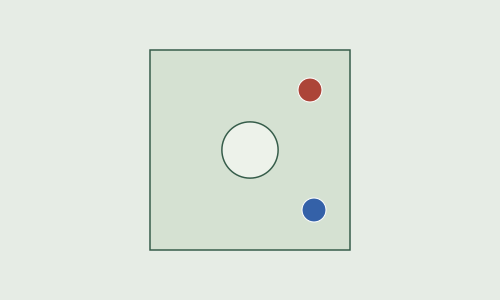
Adult play, board fronts 27 ft apart


All measurements and other layouts
| Dimension | Imperial | Metric |
|---|---|---|
| Distance | 27 ft | 8.23 m |
| Board length | 4 ft | 1.22 m |
| Board width | 2 ft | 0.61 m |
| Hole diameter | 6 in | 15.2 cm |
| Hole centre from back | 9 in | 22.9 cm |
| Board front height | 4 in | 10.2 cm |
| Board back height | 12 in | 30.5 cm |
| Pitcher box length | 4 ft | 1.22 m |
| Pitcher box width | 3 ft | 0.91 m |
| Planning length | 45 ft | 13.72 m |
| Planning width | 12 ft | 3.66 m |
ACA adult foul lines are 27 ft apart at the board fronts. The pitcher's box is 4 by 3 ft, beside the board on both sides. The stored deck is the ACL nominal size; ACA gives inch ranges.
| Dimension | Imperial | Metric |
|---|---|---|
| Distance | 15 ft | 4.57 m |
| Board length | 4 ft | 1.22 m |
| Board width | 2 ft | 0.61 m |
| Hole diameter | 6 in | 15.2 cm |
| Hole centre from back | 9 in | 22.9 cm |
| Board front height | 4 in | 10.2 cm |
| Board back height | 12 in | 30.5 cm |
| Pitcher box length | 4 ft | 1.22 m |
| Pitcher box width | 3 ft | 0.91 m |
ACA's junior-play foul-line gap is 12–15 ft between board fronts; this diagram uses the long end.
How to play
Equipment
Cornhole board
2 ×Size and equipment notes
Key size 47.5–48 in
The ACA requires at least 1/2-in plywood. ACL instead specifies a nominal 2 × 4-ft deck with tolerances.
ACA deck length is 47.5–48 in; width is 23.5–24 in. The front stands 3–4 in high and the back about 12 in.
Cornhole bag
8 ×Size and equipment notes
Key size 6 in
Each side receives four bags in its own colour.
ACA bags finish at roughly 6 in square and weigh 14–16.25 oz; ACL bags have different tolerances.
Setup
- Face the boards toward each other with their front edges 27 ft (8.23 m) apart. Each deck is a nominal 4 ft (1.22 m) by 2 ft (0.61 m), with a 6 in (15.2 cm) hole.
- Split the 8 bags evenly by colour. The board front is the foul line.
Pitch an inning
An ACA inning is one round of pitching from the same board: the two opponents alternate one bag at a time until each has pitched all four bags at the far board, eight in total. The inning is then scored, and the next inning is pitched back from the other board. (ACA rulebook, §3.2.1 and §3.3.3–3.3.4)
Under ACA rules, opponents alternate bags through the inning, and the side that scored pitches first in the next one.
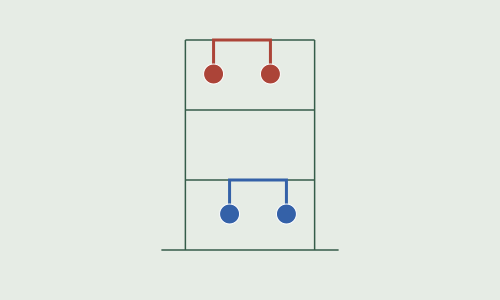
A bag that drops through the hole is worth 3 points; a bag that stays on the board is worth 1 point. When the inning ends, equal points cancel and only the difference counts, so a side can throw well and still add nothing.
Where to stand between innings
In ACA singles, opponents start at the same board in their designated lanes. After the inning they walk along those lanes to the opposite board, agree the score and pitch back. In doubles, partners stay at opposite boards in the same lane; the players at the receiving end pitch the next inning.
Pitch all four bags from the box you start in; a bag from the other box is a foul. (ACA rulebook, §3.5.3; §5.3.5)
Count the bags, then cancel
Finish the inning before counting, and leave the bags in place until both sides agree the score. Add up each side’s bags, subtract the smaller total from the larger, and give the difference to the higher side. If both sides total the same, nobody scores.
ACA traditional play
See what cancels
| Action | Points |
|---|---|
| Bag through the holeA bag knocked through by another bag has the same value. | 3 points |
| Bag resting on the boardACA calls this a Woody; any bag resting on top of the board scores, no matter where on the board it lies. | 1 point |
Cancel equal bag points; only the inning difference scores.
How the game is won
- 21 points or more
Going over: There is no bust in ACA traditional play.
Variants and house rules
ACA gives you 20 seconds to pitch each bag; ACL and ACO both give you 15. (ACA rulebook, §5.3.4; ACL rules, §4; ACO rules, §4.9)
ACA traditional play
Choose the ACA junior line tab for junior play, or for physically impaired adults or seniors when all players agree. For adult setup, measure between the board fronts and leave room beside the boards for the pitcher’s boxes.
ACL competition rules
ACL keeps the same board-front gap and cancellation values. It permits overhand delivery and uses a shorter pitch clock. See the hanger ruling below before clearing a bag caught in the hole.
ACO current web rules
ACO uses underhand delivery, cancellation scoring and a reach-or-pass finish.
ACA junior line
Use the junior range of 12–15 ft for junior play; physically impaired adults or seniors may use it too if all players agree. (ACA rulebook, §1.4.2 and §1.4.3)
The diagram selects the long end at 15 ft (4.57 m).
ACL 2026/2027Scoring & finish
ACL 2026/2027
| Action | Points |
|---|---|
| Bag through the holeA properly raked hanger that falls through becomes a hole bag. | 3 points |
| Bag on the boardA bag hanging in the hole remains one point unless a proper rake drops it. | 1 point |
Cancel equal bag points after each complete round.
How the game is won
- 21 points or more
ACO current web rulesScoring & finish
ACO current web rules
Point values match ACA traditional play.
Subtract the lower round score from the higher.
How the game is won
- 21 points or more
Common disputes
It bounced off the grass onto the board. Does it count?
No. Under ACA, ACL and ACO alike, a bag that touches the ground or court before it comes to rest on the board is dead and scores nothing. (ACA rulebook, §5.5.1; ACL rules, §4; ACO rules, §3.3)
Does a bag hanging in the hole score?
A supported hanger starts at 1 point. Under ACL rules, an official, unbiased spectator or the player who benefits least sweeps stacked bags from beneath the hole without disturbing the hanging bag. If the hanger remains, it keeps its board value. If it unavoidably drops through after a correct sweep, it becomes a hole bag. (ACL rules, §4)
If a bag hangs off the front of the board on top of a bag already on the ground, it scores 1 point if it stays on the board when the ground bag is cleared and 0 if it falls. (ACL rules, §4)
The 2023 ACA rulebook does not address a bag resting on the board while it touches the ground; ACL and ACO both score it as nothing. (ACL rules, §4; ACO rules, §3.3)
Do we have to win by two?
No. ACL rules do not require a two-point margin to win. (ACL rules, §4) ACA and ACO both end the game once a side reaches or passes the target after a complete inning. (ACA rulebook, §6.1.1; ACO rules, §3.1) The target is 21 points under all three codes. None of the three codes publishes a skunk or mercy rule, so treat one as a house rule.
Do we have to land on the target exactly?
No. ACA, ACL and ACO all use a reach-or-pass finish after the inning or round. An exact finish or drop-back penalty is a house rule.
Someone crossed the foul line. Do we leave the bag where it lands?
Under ACA rules, a foul bag that has not moved another bag is dead and comes off at once; one that has moved other bags stays in play, and the offending team drops its highest-value bag from the inning's count. A bag is foul when the player touches or crosses the foul line, starts or steps completely outside the pitcher's box before the bag is released, exceeds the pitch clock, pitches from a different box than the first bag, or does not pitch underhand. (ACA rulebook, §5.3.2–5.3.6; §5.1.2 and §5.2.2–5.2.3)
Someone moved a bag before we agreed the score. What happens?
Under ACA rules, a player may not touch, move or affect the board or bags before the score is agreed. Doing this during the inning is judged as an impacting-bag foul; after the inning ends and before the score is confirmed, the non-offending team instead receives 3 points for each bag removed. (ACA rulebook, §5.4.1–5.4.3)
Who pitches first after a scoreless inning?
Under ACA, the prior first pitcher keeps first pitch. A scoring side takes it after a scored inning.
Can I pitch overhand?
It depends on the code. ACA and ACO require underhand delivery; current ACL permits either style.
Related games
Sources
Rules used: ACA traditional play. Reviewed . How we check the rules.
Publication details and rule references
- Official Rules of Cornhole
- Revised September 23, 2023 (105744/RevG). Retrieved .
- §1, the court; §1.2.1 and §1.4.1, court and foul lines; §1.2.1, court dimensions; §1.3.1, pitcher's box; §1.4.1, foul line; §1.4.2 and §1.4.3, junior and accessibility foul lines; §1.4.2, junior-play foul line; §2.1, cornhole boards; §2.1.1, cornhole boards; §2.1.3, cornhole boards; §2.1.4, cornhole boards; §2.1.5, cornhole boards; §2.2.4, cornhole bags; §2.2.5, cornhole bags; §3.2.1 and §3.1, bags and coin toss; §3.2.1 and §3.3.3–3.3.4, innings and singles matches; §3.2.1, innings; §3.3 and §3.4, singles and doubles matches; §3.3.3 and §3.5.1, pitching order and rotation; §3.5.3, pitching; §4.1.1, cancellation scoring; §4.1.2 and §4.1.3, bag in-the-count and bag in-the-hole; §4.1.2, bag in-the-count; §4.1.3, bag in-the-hole; §5.1.2 and §5.2.2–5.2.3, foul bag violations; §5.3.2–5.3.6, list of fouls; §5.3.4, list of fouls; §5.3.5, list of fouls; §5.4.1–5.4.3, interrupting gameplay; §5.5.1, dead bags; §6.1.1, first to 21
- ACL Official Rules and Regulations
- 2026/2027; page updated 2025-10-24. Retrieved .
- §§1–2, Boards and Court Setup; §1, Bags — Physical Specifications; §4, Bag Raking/Sweeping; §4, Disturbed and Pinned Bags — Bag Hanging on Ground Bag; §4, Scoring — Bag Values; §4, Scoring Method; §4, Scoring: Disturbed and Pinned Bags, Bag Raking/Sweeping; §4, Sequence of Play — Win Condition; §4, Singles and Doubles Play; §4, Timing and Timeouts — Pitch Clock Duration
- Official Cornhole Rules
- Undated current web rules page. Retrieved .
- §3.1, Length of the Game; §3.2, Woody; §3.3, Cornhole; §3.3, Foul Bags; §3.4, Cancellation Scoring; §4.1, Singles and Doubles; §4.9, Time Limits — Pitching