
Shuffleboard Rules
One name, two sports: the painted court you push discs along with a cue, and the waxed table you slide weights down by hand.
Choose the game you have
How they differ
Surface and equipment
- Outdoor shuffleboard
- Painted court, cue and flat discs
- Table shuffleboard
- Waxed wooden table and hand-sized weights
How pieces move
- Outdoor shuffleboard
- Push discs with a cue
- Table shuffleboard
- Slide weights by hand
Who scores
- Outdoor shuffleboard
- Both sides can score in a half-frame
- Table shuffleboard
- Only the side with the leading weight scores
Scoring shape
- Outdoor shuffleboard
- Numbered triangle with a penalty area
- Table shuffleboard
- Bands at the far end with a hanger bonus
Rules used here
- Outdoor shuffleboard
- Arizona fixed-frame game on an NSA court
- Table shuffleboard
- Federation singles and partner Knock-Off
Winning condition
- Outdoor shuffleboard
- Highest score after the scheduled frames
- Table shuffleboard
- 15 points; doubles sometimes 21; events may publish another total
Count the pieces where they finish
On the court: count both colours
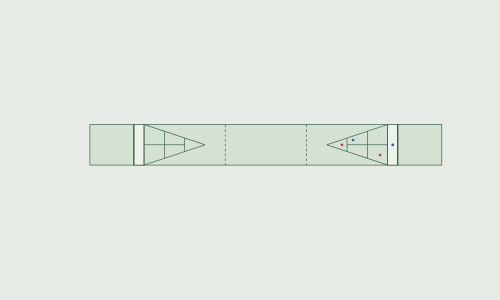
An outdoor set has 8 discs. Players deliver their discs toward the scoring triangle and count the eligible resting discs at the end of the half-frame. A disc must sit wholly inside a scoring zone to earn that zone’s value; touching a scoring line earns no zone value. A disc wholly inside the penalty area scores -10 points for its own side.
You can move a disc with a later shot, including pushing an opponent into the penalty area. Count after the last shot. See court scoring and fouls.
On the table: find the leading weight
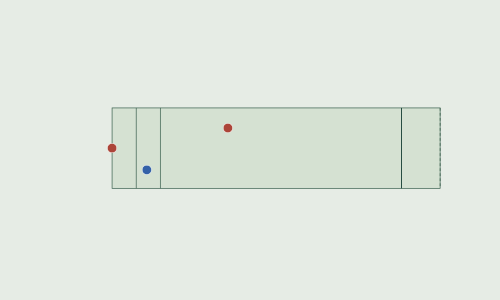
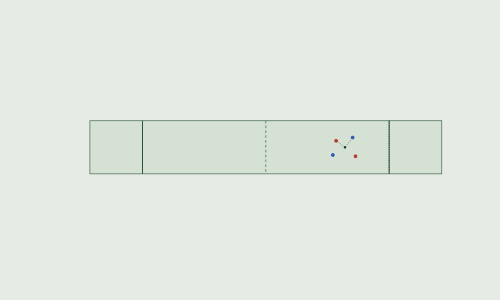
A table set has 8 weights. Only the side with the leading weight scores, and only its weights ahead of the opponent’s best weight qualify. A weight in a high-value band can earn nothing if an opponent has a better position.
The bands also use a different line test: a weight must clear a scoring line to earn the higher value. A weight that does not finish completely beyond the short foul line comes off. See the table scoring rules for hangers and tied positions before lifting the weights.
Starting order and finish
Outdoor shuffleboard
Under the December 2025 Arizona code, yellow leads the opening frame and the colour lead alternates after every frame, regardless of who scored.
The court page follows the Arizona game on an NSA court: Highest score after 12 Arizona frames. The page also explains the state-final qualifier.
The NSA sets no playing rules of its own; every National Tournament follows the rules of its host state, so the winning target changes by state.
Table shuffleboard
In the selected Federation 2024 singles and partner format, the non-hammer side shoots first and sides alternate one weight at a time. After a scoring frame the scoring side shoots first next; after a blank the previous hammer side shoots first, so hammer still switches.
The hammer is the last shot of the frame. Games go to 15 points; doubles sometimes 21; events may publish another total (Federation general rules, How to Play Table Shuffleboard; Federation table spec, §6.1). The table page also covers the older NASC format and Horse Collar.
Space for either game
For setup space: McClure's own guidance suggests at least 2 ft behind each end, though its room-length chart lists 2.5 ft as the per-end minimum and 3 ft as comfortable; more is not needed. The NSA court runs 52 ft (15.85 m) long by 6 ft (1.83 m) wide, plus room to walk each side. See court and table dimensions for the full comparison.
Related games
Sources
Reviewed . How we check the rules.
Publication details and rule references
- Official Rules of the Arizona Shuffleboard Association
- December 6, 2025. Retrieved .
- J-1–J-3, p. 5; D-6, delivery requirement; J-2 and J-4, p. 5; J-1, formal-official context; J-9, p. 5, baseline conduct; Rule A-1, p. 1; Rule D-3, p. 2; Rule D-4, p. 2, 12-frame game; Rule D-5, p. 2; Rule E-4, p. 2; Rule F-1, p. 3; Rules E-1 and F-1, pp. 2–3
- Official Rules of the National Shuffleboard Association, Inc. (web file revised 10 February 2025)
- Revised 1997, updated January 2005, January 2023, and January 2025; web file published February 10, 2025. Retrieved .
- §B.1, p. 1, discs
- Shuffleboard Rules (how-to-play overview)
- Undated live page. Retrieved .
- How to Play Table Shuffleboard, 15-point regulation game; How to Play Table Shuffleboard, doubles to 21
- Official Table Shuffleboard Rules
- 2024 Edition, February 1, 2024. Retrieved .
- §§6.3.2 and 6.4.3 exception 1; §§6.3.3.2–6.3.3.2.2, moved weights; §§6.8–6.8.1.4 and 7.1.2; §§6.8–6.8.1.4, frame scoring; §3.3 and definition 9.13, game set of four weights per side; §6.1, event criteria; §6.2.2 and exception; §§2.2 and 5.4.2; §6.3 and definition 9.15, shooting order and hammer; §6.3.3.1 and comment, out-of-turn remedies; §6.4 and definition 9.19, legal release and loss of shot; §6.8.1.1, one-point weight; §6.8.1.2, two-point weight; §6.8.1.3, three-point weight; §6.8.1.4, hanger weight; §7.1.1.1, dead heat